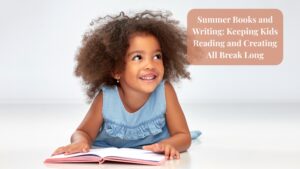
Summer Books and Writing: Keeping Kids Reading and Creating All Break Long
School ends next week, and summer stretches ahead with long days perfect for getting lost in a good book. The challenge isn’t getting kids to read, it’s helping them find the right books and giving them time to dive in.
Most kids love stories. They love getting absorbed in adventures, laughing at funny characters, and wondering what happens next. Summer is the perfect time to let them read whatever captures their attention because when kids read for fun, they read more, and reading more makes them better readers.
Here’s how to fill your summer with books kids actually want to read and writing projects that pair well with the books they are reading.
How to Find Summer Books for Kids They’ll Actually Read
The best summer reading happens when kids choose books they’re excited about. Instead of handing them a required reading list, help them discover what they love.
Start with what they already like: Does your child obsess over animals? There are field guides, animal behavior books, survival stories, and fantasy novels featuring animal characters.Does your child love video games? There are books about game design, gaming history, and fiction set in game worlds.
When kids read about topics they already care about, reading feels less like work and more like learning cool things. A child who loves soccer will devour biographies of famous players, books about World Cup history, and novels about kids who play the sport.
Use series books strategically: Once kids find a series they love, they’ll read the entire thing without prompting. Series books create momentum because kids want to know what happens next. They get attached to characters and can’t wait to see what adventure comes next.
The best part about series books is that once kids finish one, they immediately reach for the next. No convincing needed.
Mix formats: Summer books for kids don’t all have to be novels. Graphic novels count. Comic books count. Nonfiction counts. Poetry collections count. Magazines count.
Some kids prefer books with pictures. Others love factual information more than stories. While some like short chapters they can finish in one sitting. All of it builds reading skills, and all of it counts.
Visit the library weekly: Make library visits part of your routine, not a special event. Kids pick books, you check them out, you return them the next week. The library gives kids access to way more books than you could ever buy.
Librarians are incredible resources. Tell them what your child likes, and they’ll suggest titles you’ve never heard of. They know what’s popular with kids right now and can point you toward hidden gems.
We also have these great resources for finding books for kids too! Check them out:
Summer Writing Projects Connected to Books
The best writing comes from reading. When kids read books they love, they naturally want to create their own stories, explore characters more deeply, and play with ideas from what they’ve read. These writing projects build on summer books for kids by letting them create something inspired by their reading.
- Character journal from a different perspective: After finishing a book, kids pick a character and write journal entries from that character’s point of view. What was the villain thinking during the big confrontation? How did the best friend feel about the main character’s choices? What happened to the side character after the book ended?
This teaches perspective-taking and helps kids understand that every character in a story has their own motivations and feelings. It also shows them how authors make decisions about whose perspective to tell a story from.
- Write an alternate ending: What if the main character had made a different choice at the turning point? What if the story had ended differently? Kids rewrite the last chapter (or last few pages) with a new outcome.
This requires understanding the story well enough to imagine what else could have happened. It also shows kids that authors make choices, and those choices shape the entire story.
- Create a sequel or prequel scene: What happened right before the book started? What happens right after it ends? Kids write one scene that extends the story in either direction.
This is less intimidating than “write a whole story” because it’s just one scene. Kids already know the characters, the setting, and the style, so they can focus on creating something new within a familiar world.
- Design a book-inspired comic strip: Kids take their favorite scene from a book and turn it into a comic. They draw panels, write dialogue, and decide which moments to show and which to leave out.
This teaches adaptation (how do you turn a paragraph of description into a single image?) and helps kids notice how illustrations and text work together to tell a story.
- Write a letter to a character: Kids write a letter to a character giving them advice, asking questions, or telling them what they thought of their choices. Would you have done things differently? What would you ask the character if you could meet them?
This makes reading feel like a conversation. Kids engage with characters as if they’re real people, which deepens their connection to the story.
- Create a “book review” for friends: Not a school book report, but a real review like kids see on websites. What did you love about this book? Who would enjoy it? What should readers know before starting it? Would you recommend it?
Kids can write these in a notebook and share with friends, post them on family social media, start their own blog, or keep a collection to remember what they’ve read.
- Make a reading-inspired creation: After reading a book, kids make something related to it. Read a book about cooking? Try one of the recipes. Read a book about building? Construct something inspired by it. Read a fantasy novel? Draw a map of the world.
The creation doesn’t have to be writing, but kids should write a few sentences explaining what they made and how it connects to the book. This solidifies the reading experience and makes books feel like springboards for other activities.
These writing projects work because kids are creating based on something they already care about. They’re not staring at a blank page wondering what to write. They’re building on stories that already captured their imagination.
Start Right Away
You don’t need a complicated plan. Visit the library this week and let your child pick whatever looks interesting. Set up one writing project that appeals to them (journal, letters, comics, whatever sounds fun). Make both a part of your summer rhythm.
Fifteen minutes of reading before bed gives kids something to look forward to. Five minutes of writing after breakfast captures ideas while they’re fresh. These small habits add up over the summer.
Summer is the perfect time to let kids discover that books can be exciting, that writing can be creative, and that both can be fun when you’re doing them for yourself rather than for a grade. Summer books for kids and simple writing projects make that discovery happen naturally!
Happy reading and writing to you and your kids this summer!