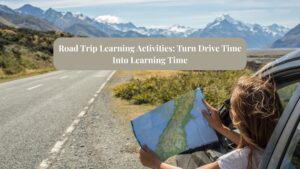
Road Trip Learning Activities: Turn Drive Time Into Learning Time
Summer road trips are part of the season’s magic. Whether you’re driving two hours to the beach or ten hours to visit family, those stretches of highway time can feel endless when you don’t have activities to fill the hours.
Long drives offer something rare in daily life: uninterrupted time together with nothing to do but talk, observe, and think. Road trip learning activities turn that drive time into opportunities for math practice, geography lessons, vocabulary building, and problem-solving.
These activities require minimal supplies (most need nothing at all), work for multiple age groups in the same car, and keep everyone engaged for miles. Here’s how to make the drive as valuable as the destination.
License Plate Geography
This classic road trip game teaches geography, observation, and data collection. The goal is simple: spot license plates from as many different states as possible.
Give each child a piece of paper to track which states they’ve seen. Younger kids can draw the state outlines or color in a map as they spot each one. Older kids can track not just which states they see but how many times they spot each state, turning it into a data collection exercise.
Take it further by discussing what you know about each state you spot. Why might there be so many New York plates on this highway? What’s the capital of that state? Have we ever been there? What’s that state known for?
This is one of those road trip learning activities that can last the entire trip. Kids stay alert and focused because they’re actively looking for something. It teaches sustained attention, pattern recognition, and geography without any formal instruction.
Mental Math Challenges
Use the constantly changing numbers around you (speed limit signs, mile markers, exit numbers, license plates) to create math problems on the fly.
For younger kids: “We just passed exit 47. What number will the next exit be?” Or “The speed limit is 65. If we slow down by 10, what speed will we be going?”
For older kids: “That license plate has 7, 3, and 9. Can you make 20 using those three numbers and any operations?” Or “We have 127 miles left. If we’re going 60 miles per hour, about how long until we arrive?”
For middle schoolers: “Gas costs $4.25 per gallon. We need 12 gallons. How much will it cost? If we pay with a $100 bill, what’s our change?”
These road trip learning activities build number sense and mental math skills. Kids learn to estimate, calculate without paper, and see math as something useful rather than something that only happens during math class. The constantly changing numbers keep the problems fresh, and you can adjust difficulty based on who’s answering.
Story Building (Round Robin Style)
Someone starts a story with one sentence. The next person adds a sentence. Keep going around the car, with each person adding to the story.
This teaches narrative structure, creativity, listening skills, and thinking on your feet. Kids have to pay attention to what others say so their sentences make sense in context. They learn about plot development, character consistency, and how stories build tension and resolution.
Younger kids often create silly, chaotic stories, which is fine. The goal is keeping the story moving forward and staying engaged with what everyone else contributes. Older kids can add rules (every sentence must include a color, or the story has to take place underwater, or each sentence must be exactly seven words) to increase the challenge.
These collaborative stories often become family legends. Years later, someone will say “remember that story about the penguin who became a detective?” and everyone will laugh. That’s the power of road trip learning activities that create shared experiences.
The Alphabet Game (With Categories)
The traditional alphabet game has everyone looking for letters A through Z in order on signs, billboards, and trucks. But you can turn this into a more educational version by adding categories.
Pick a category (animals, foods, cities, book titles, historical figures) and go through the alphabet naming things in that category. “A is for alligator, B is for bear, C is for cheetah.” When someone gets stuck, others can help.
This version teaches vocabulary, categorization, and collaborative problem-solving. It’s harder than it sounds, especially when you hit Q, X, and Z. Kids learn to think flexibly (Is a quail an animal? Yes!) and draw on knowledge they didn’t know they had.
Switch categories each round. Try countries, types of transportation, jobs people have, things you find in a kitchen, or sports. The game works for all ages because you can pick easier or harder categories based on who’s playing.
Estimation Games
Estimation is a critical math skill that doesn’t get enough practice. Road trips offer endless opportunities to estimate and then check your guess.
Before you pass a water tower, ask “How tall do you think that is?” Before you cross a bridge, ask “How long do you think this bridge is?” When you see a truck, ask “How many boxes do you think fit in that truck?”
After everyone guesses, look up the answer (if possible) or discuss what a reasonable answer might be. Was anyone close? Were all the guesses too high or too low? What clues could help you make a better estimate next time?
These road trip learning activities teach approximation, spatial reasoning, and the difference between a wild guess and an educated estimate. Kids learn to use reference points (that truck is about twice as tall as our car, and our car is about six feet tall, so the truck is probably 12 feet tall) to make smarter guesses.
20 Questions (Strategic Thinking Version)
One person thinks of something (an animal, a place, an object, a person). Everyone else gets 20 yes-or-no questions to figure out what it is.
The key is asking strategic questions that eliminate large categories. Instead of guessing specific animals (“Is it a dog?”), smart questions narrow the field (“Is it a mammal?” “Does it live in water?” “Is it larger than a car?”).
This teaches logical thinking, categorization, and question formulation. Kids learn to think strategically about which questions will give them the most useful information. They also learn to listen carefully to previous answers so they don’t waste questions on things that have already been ruled out.
Younger kids will guess randomly at first, but they learn strategy by watching older siblings or parents model good questioning. Over time, they develop better analytical thinking skills.
Storytelling With Road Signs
Turn the signs you pass into a story prompt. Every time you see a sign, you have to incorporate what it says into an ongoing story.
If you pass a sign that says “Rest Area 2 Miles,” someone might say “The hero was exhausted and knew they needed to rest, but the villain was only 2 miles behind them.” The next sign might say “Construction Ahead,” so the next person adds “When they reached the rest area, they found it was under construction and completely unusable.”
This is one of the most creative road trip learning activities because it forces kids to think quickly and adapt their storytelling to random inputs. They can’t plan ahead because they don’t know what the next sign will say. It teaches flexibility, improvisation, and how to connect unrelated ideas into a coherent narrative.
What Makes Road Trip Learning Activities Work
The best road trip learning activities share a few key elements. They require no special materials beyond what’s already in the car or visible out the window. They’re flexible enough to adjust for different ages and skill levels, they encourage conversation and interaction rather than silent individual work and they make learning feel like playing.
When kids engage in these activities, they’re practicing real skills: mental math, strategic thinking, vocabulary, geography, estimation, and creative problem-solving. But they’re not sitting at a desk filling out worksheets. They’re laughing, competing, collaborating, and watching the miles fly by.
Road trip learning activities also create family memories. The estimation game where nobody came even close. The collaborative story that got so ridiculous everyone was crying laughing. The license plate from Alaska spotted in the middle of Pennsylvania. These moments matter more than any destination.
The next time you’re planning a summer road trip, pack these activities alongside the snacks and playlists. Your kids will stay engaged, learn something useful, and remember the drive just as much as wherever you’re going.
At Delphi Academy, we believe learning happens everywhere, not just in classrooms. Road trips are perfect opportunities to practice skills in real contexts where they actually matter.