
Gardening With Kids: What They Actually Learn From Growing Food
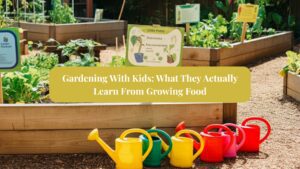
Your child plants a seed, waters it, and checks on it every day. Nothing happens for a while, but then one morning, a tiny green shoot pushes through the soil.
This moment is pure magic for kids, but here’s what most parents don’t realize: gardening with kids teaches concepts that workbooks can’t touch. Math, science, patience, observation, responsibility, and problem-solving all happen naturally when children grow something from a seed to a plant they can eat.
May is the perfect time to start because the weather is getting warm and a small garden will teach lessons that will stick to the end of the school year, and far beyond summer.
Here’s what kids actually learn when you start gardening with kids.
Math Lives in the Garden
Most children think math lives in textbooks as numbers on a page, problems to solve, and answers to get right or wrong. Gardening with kids changes that because math becomes something you use.
Measurement: How deep should the hole be? The seed packet says half an inch, so your child measures with a ruler. They dig, check the depth, and adjust if it’s too deep or not deep enough. This is practical geometry, fractions, and estimation with real-time correction.
Spacing: The instructions say to plant seeds six inches apart, which makes kids wonder why. What happens if you plant them closer or further apart? Kids start thinking about area, about how much space a plant needs when it grows, and about planning ahead.
Counting and patterns: Plant three seeds in each hole and count them. How many holes do we need for 12 seeds? If we have four rows, how many plants will we have in total? Multiplication suddenly has a purpose.
Time and growth tracking: How many days have passed since we planted? How tall is the plant today? How much did it grow this week? Create a simple chart, measure height, record observations, and graph the results. This is data collection, creating visual representations of information, and real-world math.
Science Happens Every Day
Gardening with kids is a living science experiment where every day brings new observations.
Plant life cycles: Kids learn that seeds don’t just magically become plants. There’s a process that includes germination, growth, flowering, fruiting, and seeds again. Understanding cycles is foundational science, whether we’re talking about weather cycles, water cycles, or life cycles.
Cause and effect: What happens if we don’t water the plants? What happens when we water them? What happens if a plant doesn’t get enough sun? What about too much sun? Kids make hypotheses, test them, and observe results, which is the scientific method practiced daily.
Soil composition: Dig in the dirt and ask what you see. Are there rocks? Worms? Old leaves breaking down? Talk about what soil is made of, how it provides nutrients, and why some soil is better for growing than others. This leads to conversations about decomposition, ecosystems, and how everything connects.
Companion planting: Some plants grow better together, like tomatoes and basil or carrots and onions. Why does this happen? Kids start thinking about relationships in nature, about how plants can help or hurt each other, and about balance in an ecosystem.
Patience Becomes Real
We live in a world of instant results where kids tap a screen and something happens immediately, or they ask a question and Google answers in seconds. Gardening with kids teaches the opposite because some things take time, and you can’t rush growth.
Delayed gratification: Plant a seed today, and it might take a week to sprout, even longer to flower, and longer still to produce food you can eat. Kids learn to wait, to trust the process, and to keep doing the work even when they can’t see results yet. This is one of the most valuable lessons gardening teaches: good things take time.
Daily care builds habits: Plants need water every day, not when you remember or when it’s convenient, but every single day. This builds consistency and teaches that living things depend on regular care, and that your actions (or lack of action) have real consequences.
Accepting failure: Sometimes seeds don’t sprout, sometimes plants die, and sometimes something eats your tomatoes before you can pick them. Gardening with kids teaches resilience because you try again, plant more seeds, figure out what went wrong, and adjust. This lesson is more valuable than any plant you’ll grow.
Observation Skills Develop Naturally
Gardening with kids slows them down and trains them to notice.
Daily check-ins: Is the soil dry? Are there bugs? Did the plant grow? Are the leaves a different color? These questions teach kids to observe before acting, to gather information, and to look for changes over time.
Pattern recognition: After a few weeks, kids start noticing patterns. The plant grows faster after rain, leaves turn yellow when it needs nutrients, and certain bugs show up at certain times. Pattern recognition is critical thinking and forms the foundation of prediction and planning.
Sensory engagement: Gardening with kids engages all five senses through the smell of basil, the texture of dirt, the sound of rustling leaves, and the taste of a sun-warmed strawberry. Multi-sensory learning sticks because kids remember what they experience.
Responsibility Becomes Concrete
Gardening with kids makes responsibility concrete and visible.
Someone depends on you: If you forget to water the plants, they die, and this isn’t theoretical because it’s visible and immediate. Kids see the direct result of their actions, or their inaction, which teaches accountability in a way that lectures never will.
Following through matters: You can’t plant seeds, water them once, and walk away because growing things requires sustained effort. Gardening with kids teaches that starting isn’t enough because you have to finish, maintain, and show up consistently.
Problem-solving is ongoing: The plant is wilting, so you have to figure out why. Is it too much water? Not enough? Are there pests? Is it a disease? Is it in the wrong location? Kids learn to diagnose problems, try solutions, and observe whether the solution worked. This is troubleshooting and critical thinking in action.
Starting Small: What You Actually Need
You don’t need a big yard to start gardening with kids. You don’t need expensive tools or expert knowledge.
You need:
- A container (pot, bucket, old drawer)
- Soil
- Seeds or seedlings
- Water
- Sunlight
- Patience
Easy plants for beginners:
- Lettuce (fast, grows in partial shade, hard to kill)
- Radishes (sprout in days, ready to eat in 3-4 weeks)
- Cherry tomatoes (productive, delicious, forgiving)
- Herbs (basil, mint, parsley grow easily)
- Sunflowers (fast-growing, impressive, kids love the height)
- Green beans (climb, produce lots, kids can pick and eat)
At Delphi Academy, Hands-On Learning Is the Standard
At Delphi, students don’t just read about photosynthesis because they observe it happening. They don’t just learn about measurement because they use it for real purposes. Gardening with kids embodies everything we believe about education because learning happens through doing, concepts stick when students apply them, and understanding deepens through observation and experience.
When students at Delphi study science, they conduct experiments. When they study math, they solve actual problems. When they learn about ecosystems, they engage with them directly. This is how knowledge becomes real.
Start This May
You don’t need to wait, you don’t need a plan, and you don’t need everything figured out. Buy a packet of seeds, find a pot, add soil, and let your child plant something. Then step back and watch what happens, not just to the plant, but to your child.
Watch them check on it every morning, notice when it needs water, measure its growth, and see their face light up when the first tomato turns red. That’s gardening with kids, and it teaches far more than just what you planted.