Fall Baking Is Secretly a Science Lab
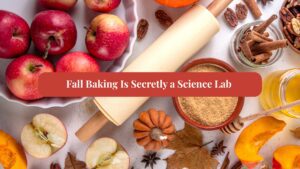
Every fall, kitchens around Boston fill up with apple pies, pumpkin bread, and cider donuts. Every one of those recipes is a chemistry experiment with edible results. Gases expand, proteins build scaffolding, living organisms breathe, and sugar transforms under heat, all before dessert.
Baking science for kids just needs a recipe, a curious kid, and a parent willing to ask “what do you think will happen?” before the oven door closes. Here are four experiments hiding inside your fall baking, and how to run them for real.
Experiment #1: Sacrifice a Batch to Science
Start with the biggest mystery in the pantry: why does a recipe call for baking soda sometimes, baking powder other times, and occasionally both? The short answer is that baking soda needs an acid to work, while baking powder brings its own acid to the party. When either one meets liquid (and acid), it releases carbon dioxide bubbles, and those bubbles are the entire reason your muffins aren’t flat and rock solid.
Test it out with your kids rather than explain it: Make a half batch of pumpkin muffins the right way, then make the other half batch with the baking soda left out, and let your child predict what will happen before both go in the oven. Comparing the tall, fluffy muffin to the sad, dense one is a controlled experiment, the exact method real scientists use, and sacrificing one batch to science is the most fun because your kid will have made a mistake on purpose in the name of discovery. The dense ones still taste fine with cider, which is more than most labs can say about their results.
Experiment #2: The Apple That Wouldn’t Brown
If you picked apples this fall (say, at C.N. Smith Farm in East Bridgewater), you’ve seen the problem: slice them for a pie, and the cutting board turns brown before the crust is rolled. Why?
Cutting an apple breaks open its cells, letting an enzyme inside of it meet the oxygen in the air, and the reaction paints the fruit brown. Acid slows that enzyme down, which is why bakers sprinkle lemon juice on their slices. Turn it into a real experiment: set out apple slices coated in lemon juice, some in milk, some in water, and some with nothing at all, have your child predict the ranking, and check back in an hour. Science Buddies has a full version of this experiment if your child wants to go deeper. The great thing about this experiment, simply rinse off your apple slices afterward and bake them in your pie!
Experiment #3: Yeast Is Alive (Prove It)
Here’s a fact that stops most kids mid-stir: that beige powder in the bread recipe is alive. Yeast is a single-celled fungus, and when you give it warm water and sugar, it eats, and it exhales carbon dioxide. Those tiny breaths are what make bread rise. Your sandwich is fluffy because a billion microscopic organisms breathed into the dough.
Prove it with a balloon: mix yeast, warm water, and sugar in a bottle, stretch a balloon over the top, and watch the yeast blow it up over the next hour. The Exploratorium’s yeast-air balloon activity adds great variations: race warm water against cold, or race yeast against baking powder, and let your child figure out why one wins. This is baking science for kids at its best, because the experiment ends in fresh bread you all get to enjoy together.
Experiment #4: The Golden-Brown Mystery
Last question, asked at the oven window: why does everything in there turn golden brown and start smelling incredible? The answer is the Maillard reaction, a reaction between proteins and sugars that only kicks off at high heat. It’s the same chemistry behind seared steak, toasted marshmallows, and the crust on your pumpkin bread. It’s also why recipes brush pastry with egg: the egg adds extra protein for the reaction, which is what makes a pie crust shine.
The observation game: pull a loaf out early and compare the pale top to a fully baked one, or toast one slice of bread light and one dark and taste the difference. Where did the new flavor come from? It wasn’t in the ingredients, it was heat that built it.
The Rules of the Kitchen Lab
A few habits turn baking science for kids from a demonstration into real thinking:
- Predict first, always. “What do you think happens if we leave out the baking soda?” The prediction is the science; the muffin is just the evidence.
- Change one thing at a time. One batch without soda, not without soda AND eggs. Ask your child why that rule matters, and let them reason it out.
- Let them run it. Kids can measure, mix, set timers, and record results. A child who ran the experiment owns the answer; a child who watched one just saw a trick.
- Wrong predictions are the good ones: A kid whose muffin theory just got flattened by the actual muffin is a kid doing real science.
At Delphi Academy, this is how we approach all learning: master the concept, then use it in the real world, because knowledge you’ve put to work is knowledge you own. The kitchen has been a laboratory all along but fall is when the experiments taste the best.